At this year’s Association for Molecular Pathology (AMP) Europe 2026 Congress in Tallinn, Estonia, Associate Professor Dr. Nina Bondarenko presented the results of her research on the non-invasive monitoring of lung transplant function. The congress brought together nearly 250 participants from 38 countries worldwide. The scientific program included 15 scientific sessions, 24 oral presentations, 79 poster presentations, and several industry-sponsored talks.
In 2023/24, Dr. Bondarenko worked as a visiting scientist at Hannover Medical School. The DZL project on which her work is based was carried out at the Institute of Pathology in close cooperation with the Department of Pneumology and Infectious Diseases. She has since returned to her home institution, Dnipro State Medical University in Ukraine, where she works in the Department of Pathological Anatomy, Forensic Medicine and Pathological Physiology.
Dr. Bondarenko presented a proof-of-concept pilot study investigating whether donor-derived cell-free DNA (dd-cfDNA) in the blood of lung transplant recipients can serve as an early biomarker of lung allograft injury. The study involved the development and analytical validation of a targeted SNP-based next-generation sequencing (NGS) assay that enables accurate quantification of donor-derived DNA at very low levels. Notably, the approach adapts a targeted SNP panel originally developed for human identity testing to the field of lung transplantation, demonstrating the translational potential of existing NGS technologies for non-invasive graft monitoring.
The assay was evaluated using samples from the Hannover Medical School lung transplantation cohort. In the clinical pilot study, plasma samples from ten lung transplant recipients were analyzed, while samples from two healthy volunteers were used to generate defined reference mixtures for analytical validation. The assay demonstrated very strong agreement between expected and measured donor DNA proportions.
“My abstract was not only accepted as a poster but was also selected for an oral presentation,” says Dr. Bondarenko. “This recognition highlights the scientific significance of our work.”
The approach is particularly promising because the current standard diagnostic method, transbronchial biopsy, is invasive and may be limited by sampling variability and differences in histopathological assessment. Initial findings suggest that elevated dd-cfDNA levels may indicate clinically relevant lung allograft injury even in cases where routine biopsy does not yet show evidence of acute rejection.
Source: 1) Poster “Donor-Derived Cell-Free DNA for Non-invasive Monitoring of Lung Transplant Function: A Proof-of-Concept Pilot Study Using a Targeted SNP-Based NGS Assay” (N. Bondarenko et al.; Poster No. OTH-01, Abstract No. 51).
Text: BREATH/ AZ
Photo: private
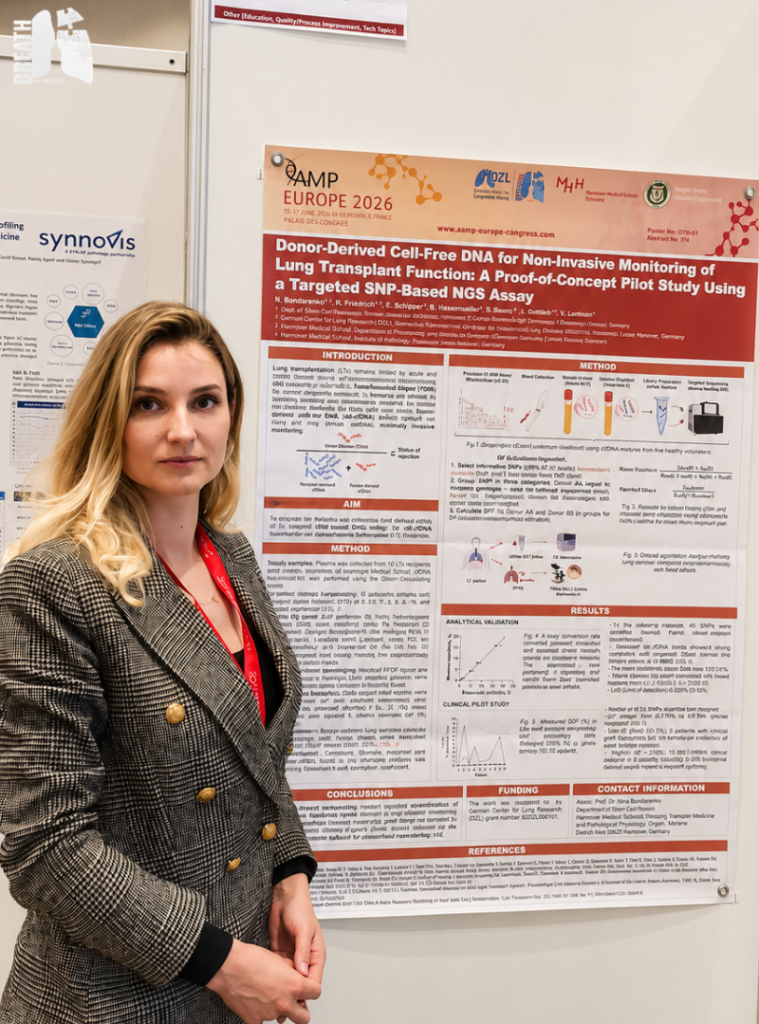
Associate Professor Dr. Nina Bondarenko at the Association for Molecular Pathology (AMP) Conference in Tallinn, Estonia