> Optimized Active Compounds Against RSV – Research project “OPERA” launched to further develop antiviral agents
Optimized Active Compounds Against RSV – Research project “OPERA” launched to further develop antiviral agents
An interdisciplinary consortium consisting of researchers from TWINCORE, the Center for Experimental and Clinical Infection Research, the Helmholtz Institute for Pharmaceutical Research Saarland (HIPS), the Helmholtz Centre for Infection Research (HZI) in Braunschweig, the University of Lübeck, the German Center for Lung Research at the Hannover site (BREATH), and Hannover Medical School has received funding of approximately €999,000 from the Volkswagen Foundation. Under the leadership of Prof. Thomas Pietschmann, the team aims to optimize compounds against the respiratory syncytial virus (RSV) over the next two years.
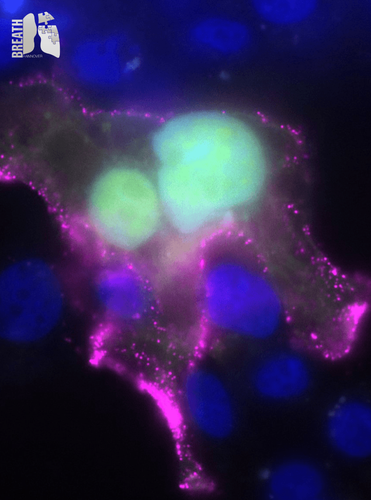
RSV causes respiratory infections that can be severe, particularly in young children and older adults. According to the World Health Organization (WHO), around 3.6 million children under the age of five are hospitalized each year due to RSV infections, and 100,000 of them die as a result of the infection. Currently, only supportive treatments such as oxygen administration are available. The consortium therefore aims to develop new treatment options as part of the “OPERA” project (optimising pan-entry RSV antivirals).
“To enter human cells, the virus must fuse with the membrane,” says Prof. Pietschmann. The Director of the Institute for Experimental Virology at TWINCORE in Hannover and Principal Investigator at BREATH is leading the research project. The fusion protein, or F protein, plays a key role in this process. In previous work, the research team identified inhibitors that can very effectively block fusion at the cell surface and thus prevent infection. However, they are not very effective against alternative fusion within the cell, which likely occurs in an environment with a lower pH. Therefore, the fusion inhibitors are to be optimized so that they remain active across a broader pH range. This would significantly improve their effectiveness.
In addition, a formulation suitable for inhalation is to be developed in order to deliver the active compound quickly and directly to the lungs. The compound will first be extensively tested in human primary cells. Its uptake, distribution, metabolism, and tolerability will also be examined to better understand and improve the pharmacokinetics and pharmacodynamics of the substances. Subsequently, efficacy will be demonstrated in an animal model.
In addition to the team led by Prof. Thomas Pietschmann, which is responsible for virological profiling, several other research groups are involved in the project. The group led by Prof. Gesine Hansen, Medical Director of the Clinic for Pediatric Pneumology, Allergology and Neonatology at Hannover Medical School and site director of BREATH, is particularly responsible for demonstrating in vivo proof of concept in a lung infection model.
Once the defined milestones have been achieved, the industrial partner ENYO Pharma SA will take over preclinical development through to initial studies in humans.
Text: TWINCORE – Centre for Experimental and Clinical Infection Research
Photo: ©TWINCORE/S. Haid & A. Carpentier
You might also be interested in these news items:
3D-Printed Membrane Paves the Way for a Biohybrid Lung
Die Forschung im Bereich der Bronchiektasen hat in den vergangenen 15 Jahren eine deutliche Dynamik erfahren. Dennoch bleibt die zugrundeliegende Ursache bei etwa 38 Prozent der Fälle trotz umfassender Diagnostik ungeklärt, sodass die Erkrankung als idiopathisch eingestuft wird – wie Daten …
Read articlePoster Award for Joint Organoid Imaging Project
Die Forschung im Bereich der Bronchiektasen hat in den vergangenen 15 Jahren eine deutliche Dynamik erfahren. Dennoch bleibt die zugrundeliegende Ursache bei etwa 38 Prozent der Fälle trotz umfassender Diagnostik ungeklärt, sodass die Erkrankung als idiopathisch eingestuft wird – wie Daten …
Read articlePulmonary Fibrosis in Childhood: New Findings from the chILD Registry
Die Forschung im Bereich der Bronchiektasen hat in den vergangenen 15 Jahren eine deutliche Dynamik erfahren. Dennoch bleibt die zugrundeliegende Ursache bei etwa 38 Prozent der Fälle trotz umfassender Diagnostik ungeklärt, sodass die Erkrankung als idiopathisch eingestuft wird – wie Daten …
Read articleHow Lung Transplant Recipients Can Live Longer with a New Lung
Die Forschung im Bereich der Bronchiektasen hat in den vergangenen 15 Jahren eine deutliche Dynamik erfahren. Dennoch bleibt die zugrundeliegende Ursache bei etwa 38 Prozent der Fälle trotz umfassender Diagnostik ungeklärt, sodass die Erkrankung als idiopathisch eingestuft wird – wie Daten …
Read articleUkrainian Visiting Scientist Presents DZL Project at AMP Europe 2026 in Tallinn
Die Forschung im Bereich der Bronchiektasen hat in den vergangenen 15 Jahren eine deutliche Dynamik erfahren. Dennoch bleibt die zugrundeliegende Ursache bei etwa 38 Prozent der Fälle trotz umfassender Diagnostik ungeklärt, sodass die Erkrankung als idiopathisch eingestuft wird – wie Daten …
Read articleBREATH successfully represented at the DZL Annual Meeting 2026 in Wiesbaden
Die Forschung im Bereich der Bronchiektasen hat in den vergangenen 15 Jahren eine deutliche Dynamik erfahren. Dennoch bleibt die zugrundeliegende Ursache bei etwa 38 Prozent der Fälle trotz umfassender Diagnostik ungeklärt, sodass die Erkrankung als idiopathisch eingestuft wird – wie Daten …
Read articleThorben Pape conducts research on acute respiratory distress syndrome in the PRACTIS programme
Die Forschung im Bereich der Bronchiektasen hat in den vergangenen 15 Jahren eine deutliche Dynamik erfahren. Dennoch bleibt die zugrundeliegende Ursache bei etwa 38 Prozent der Fälle trotz umfassender Diagnostik ungeklärt, sodass die Erkrankung als idiopathisch eingestuft wird – wie Daten …
Read articleBREATH scientist Dr. Carola Voss receives the Rudolf Buchheim Award 2026
Die Forschung im Bereich der Bronchiektasen hat in den vergangenen 15 Jahren eine deutliche Dynamik erfahren. Dennoch bleibt die zugrundeliegende Ursache bei etwa 38 Prozent der Fälle trotz umfassender Diagnostik ungeklärt, sodass die Erkrankung als idiopathisch eingestuft wird – wie Daten …
Read articleWhy traction bronchiectasis is not true bronchiectasis
Die Forschung im Bereich der Bronchiektasen hat in den vergangenen 15 Jahren eine deutliche Dynamik erfahren. Dennoch bleibt die zugrundeliegende Ursache bei etwa 38 Prozent der Fälle trotz umfassender Diagnostik ungeklärt, sodass die Erkrankung als idiopathisch eingestuft wird – wie Daten …
Read articleIntermediate CFTR function as a novel approach to understanding bronchiectasis
Die Forschung im Bereich der Bronchiektasen hat in den vergangenen 15 Jahren eine deutliche Dynamik erfahren. Dennoch bleibt die zugrundeliegende Ursache bei etwa 38 Prozent der Fälle trotz umfassender Diagnostik ungeklärt, sodass die Erkrankung als idiopathisch eingestuft wird – wie Daten …
Read articleA lung-protective factor in focus: New insights into S100A8 in pneumonia
Die Forschung im Bereich der Bronchiektasen hat in den vergangenen 15 Jahren eine deutliche Dynamik erfahren. Dennoch bleibt die zugrundeliegende Ursache bei etwa 38 Prozent der Fälle trotz umfassender Diagnostik ungeklärt, sodass die Erkrankung als idiopathisch eingestuft wird – wie Daten …
Read articleLong COVID: Monocyte cell state links immune dysregulation to pulmonary function
Die Forschung im Bereich der Bronchiektasen hat in den vergangenen 15 Jahren eine deutliche Dynamik erfahren. Dennoch bleibt die zugrundeliegende Ursache bei etwa 38 Prozent der Fälle trotz umfassender Diagnostik ungeklärt, sodass die Erkrankung als idiopathisch eingestuft wird – wie Daten …
Read article